
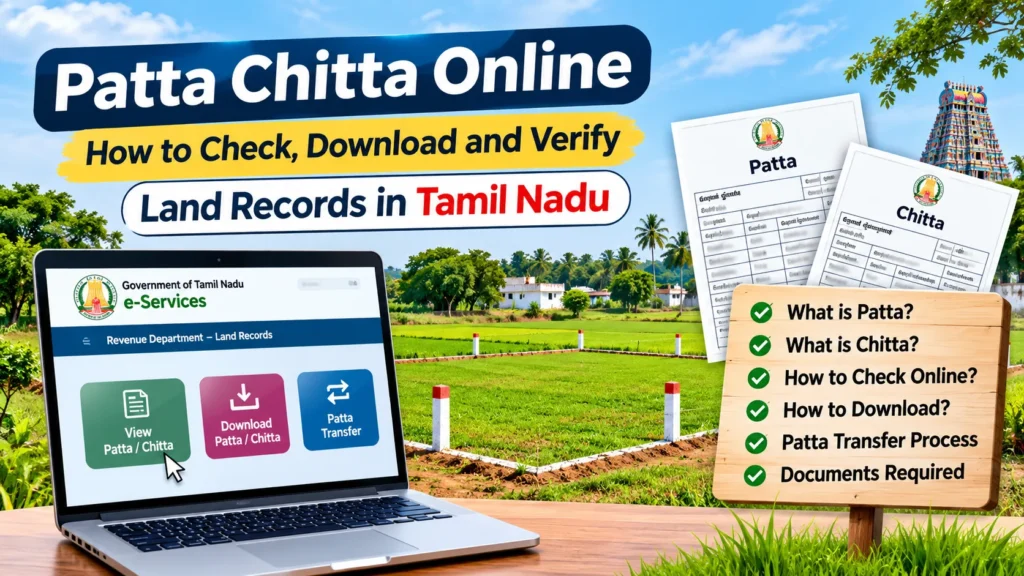
Patta Chitta Online: How to Check, Download and Verify Land Records in Tamil Nadu
Buying land or owning a property in Tamil Nadu involves several important documents. Among them, Patta Chitta is one of the most commonly discussed land-record documents. Whether you are purchasing a residential plot in Chennai, inheriting agricultural land in a village, or verifying property details before making an investment, understanding Patta Chitta is essential.
Many property buyers search for Patta Chitta online because they want to confirm land details, check survey numbers, verify the recorded owner’s name and understand the classification of a property.
For example, imagine you are planning to purchase a residential plot in Tambaram. The seller shows you a sale deed and claims that the property has clear ownership. Before proceeding, you should also check the available land records to see whether the survey number, extent and recorded owner’s details match the property documents.
This is where Patta Chitta becomes useful.
Tamil Nadu provides an online land-record service that allows citizens to access eligible land-related information without always visiting a government office.
In this guide, you will learn what Patta and Chitta mean, how to check Patta Chitta online, how to download the records, how Patta transfer works and what property buyers should verify before purchasing land.
1. What Is Patta?
Patta is a government land-revenue record maintained by the Tamil Nadu Revenue Department. It contains important information about land and the person or persons recorded as its pattadars.
A Patta generally includes details such as:
Patta number
Name of the recorded landowner or pattadar
District and taluk
Village name
Survey number
Subdivision number, where applicable
Land extent
Relevant land classification details
Real-Life Example:
Suppose a person owns 2,400 square feet of land in Guduvanchery. The owner wants to sell the property to another individual.
The prospective buyer can check the available Patta details to understand whose name is recorded in the revenue records and whether the survey number and land extent correspond with the property documents.
However, Patta should not be treated as conclusive proof of legal ownership. A proper title verification is also necessary before purchasing land.
2. What Is Chitta?
Chitta is a traditional Tamil Nadu land-revenue record containing details about land classification and ownership-related revenue information.
Historically, Chitta records helped identify whether land was classified as wetland (Nanjai) or dryland (Punjai), along with relevant ownership details.
These classifications are important because the nature and permitted use of land can affect property-related decisions.
Nanjai: Generally refers to wet agricultural land, often associated with irrigation.
Punjai: Generally refers to dry agricultural land.
Today, Tamil Nadu has integrated important land-record information into its online e-Services system. Therefore, citizens can access relevant Patta and land-record information through the official portal.
3. Difference Between Patta and Chitta
Although Patta and Chitta are commonly discussed together, they traditionally served different purposes in Tamil Nadu’s revenue administration.
Patta is a revenue record identifying the recorded pattadar and containing relevant land details.
Chitta traditionally contained information about land classification, including whether the land was Nanjai or Punjai.
Today, important information from these traditional records is available through integrated online land-record services in Tamil Nadu.
4. Why Is Patta Chitta Important When Buying Land?
Before purchasing a property in Tamil Nadu, checking Patta Chitta is an important part of the preliminary verification process.
It helps buyers understand the revenue-record details associated with the land.
Verify the recorded owner’s name: Check whether the seller’s name matches the available revenue records. If the name differs, ask for supporting documents explaining the difference.
Confirm the survey number: Every land parcel is associated with a survey number and, where applicable, a subdivision number. Compare these details with the seller’s sale deed.
Understand land classification: Check whether the property is classified as Nanjai, Punjai or another relevant category. Do not assume that agricultural land can automatically be used for residential development.
Check land extent: Compare the extent mentioned in the Patta with the sale deed and other available survey records.
Identify discrepancies before purchasing: Differences in names, survey numbers or land extent should be investigated before paying an advance or signing an agreement.
Real-Life Example: Purchasing a Plot in Chennai
Imagine a buyer wants to purchase a 1,200-square-foot residential plot in Perungalathur.
The seller provides a sale deed showing Survey No. 125/3A. However, the available Patta record displays a different subdivision.
Instead of ignoring this difference, the buyer should request clarification, verify the subdivision details and obtain appropriate legal and survey verification.
A small discrepancy in land records can become a major problem during registration, construction approvals or future resale.
Remember: Patta Chitta verification is one part of property due diligence, not a substitute for a complete title search.
5. How to Check Patta Chitta Online in Tamil Nadu
One of the most common searches among Tamil Nadu property owners is “How to check Patta Chitta online?”
The Tamil Nadu government provides an official e-Services portal where citizens can access eligible land-record information.
Follow these steps:
Step 1: Visit the Official Website
Open the Tamil Nadu e-Services portal:
Step 2: Select the Relevant Land-Record Service
Choose the appropriate option to view Patta/Chitta or the relevant land-record extract.
Step 3: Select the Property Location
Enter the required details, such as:
District
Taluk
Village
Urban or rural land category, where applicable
Step 4: Enter the Survey Details
Provide the survey number and subdivision number, or the Patta number, depending on the available search option.
Step 5: Complete Verification
Enter the displayed verification code or CAPTCHA, if requested.
Step 6: View the Land-Record Details
Submit the information and review the available land-record extract.
Check the recorded owner’s name, survey number, subdivision, land extent and classification.
Step 7: Save the Details
If the portal provides a download or print option, save the extract as a PDF for your reference.
Note: Portal layout and available options may change. Follow the current instructions displayed on the official website.
6. How to Download Patta Chitta Online
After checking the land details, many users want to download Patta Chitta for property verification or personal records.
The process is straightforward when the relevant record is available online.
Visit the official Tamil Nadu e-Services website.
Select the relevant Patta/Chitta viewing service.
Enter the property location details.
Provide the required Patta or survey number information.
Complete the verification process.
View the available land-record extract.
Use the print or download option if available.
Save the downloaded document in a secure location.
If you are purchasing land, retain a copy alongside the sale deed, Encumbrance Certificate and other property documents.
Important: Check whether the downloaded extract is digitally verifiable and whether the receiving authority requires a particular certified copy or official document format. A downloaded reference extract may not satisfy every legal or administrative requirement.
7. Documents Required for Patta Transfer in Tamil Nadu
Patta transfer is necessary when the recorded landowner changes or when eligible changes need to be made to existing revenue records.
Common situations include:
Purchasing land through a registered sale deed
Inheriting property from parents
Transferring land following a legal succession
Updating joint ownership details
Requesting subdivision of land
Depending on the nature of the application, the following documents may be required:
Registered sale deed
Existing Patta details
Applicant’s identity details
Previous ownership documents
Legal heir certificate, where applicable
Death certificate, where applicable
Relevant survey details
Other supporting documents requested by the authorities
Not every applicant needs to submit every document. The exact requirements depend on the type of transfer and the individual property’s circumstances.
8. How to Apply for Patta Transfer Online
Suppose you have purchased a residential plot in Chennai and completed the property registration. You now want to update the revenue records with the new owner’s details.
This process is known as Patta transfer.
Tamil Nadu provides online and e-Sevai-based channels for eligible Patta transfer services.
The general process is:
Identify the appropriate Patta transfer service.
Submit the application through the available official channel or authorised e-Sevai centre.
Provide the registered property documents and other required details.
Obtain the application acknowledgement or reference number.
Track the application using the available status facility.
Respond to any additional document or verification requests.
Check the updated revenue record after approval.
Tamil Nadu’s e-Sevai service list includes different categories such as full-field Patta transfer, joint Patta transfer and subdivision services. Select the category that matches your situation.
You can also visit the nearest authorised e-Sevai centre if you need assistance with the application.
Tip: Keep your application acknowledgement safely. It will help you follow up if the application requires further verification.
9. Common Patta Chitta Problems and Their Solutions
Sometimes, property owners discover errors or unexpected information while checking Patta Chitta online. Understanding how to handle these situations can prevent unnecessary delays.
Problem 1: Owner’s Name Is Incorrect
You may find that the Patta still displays the previous owner’s name even after purchasing the property.
Solution: Check whether the Patta transfer application was completed. If the records have not been updated, follow up with the relevant Revenue Department office and provide the registered sale deed and supporting documents.
Problem 2: Survey Number Mismatch
The survey number in your sale deed may differ from the online land records.
Solution: Compare the original deed, subdivision details and relevant survey records. Consult the Taluk Survey Department or a qualified property lawyer if necessary.
Problem 3: Patta Details Are Not Available Online
Sometimes, users cannot find their property details on the portal.
Solution: Recheck the district, taluk, village and survey number. If the problem continues, contact the relevant Taluk office or authorised e-Sevai centre.
Problem 4: Patta Transfer Application Is Pending
An application may remain pending because additional verification or documents are required.
Solution: Use the application reference number to check its status. Contact the relevant revenue authority if further action is required.
Problem 5: Land Extent Is Incorrect
The extent mentioned in the online Patta may not match the sale deed.
Solution: Obtain the relevant survey and subdivision records and request correction through the appropriate official process if an error is established.
Do not attempt to resolve ownership disputes simply by making online changes. Such cases may require supporting legal documents and official verification.
10. Important Things to Verify Before Buying a Property in Tamil Nadu
Checking Patta Chitta is important, but experienced property buyers know that a single document is never enough to establish that a property has a clear and marketable title.
Before purchasing a plot, agricultural land or residential property, consider checking the following:
1. Patta: Verify the recorded owner, survey number and land extent.
2. Sale Deed: Check the ownership transfer and property description.
3. Encumbrance Certificate (EC): Review registered transactions and recorded encumbrances within the search period.
4. Parent Documents: Review the previous ownership history.
5. A-Register Extract: Verify relevant revenue and land classification details.
6. FMB Sketch: Check survey boundaries and measurements.
7. Layout Approval: Verify applicable planning and layout permissions.
8. Legal Heir Documents: Review ownership succession documents, where applicable.
Real-Life Example: Why Checking Multiple Documents Matters
Consider a family planning to purchase a 2,400-square-foot plot near OMR, Chennai.
The seller provides a Patta showing their name. Everything appears correct initially.
However, during further verification, the buyer discovers that the property extent mentioned in the sale deed does not match the survey-related records.
If the buyer had relied only on Patta, this discrepancy might have gone unnoticed.
By checking the sale deed, EC, parent documents and relevant survey records, the buyer can identify potential issues before proceeding with the transaction.
For larger investments, obtaining an independent legal opinion and physical survey verification is a sensible precaution.
11. Frequently Asked Questions About Patta Chitta
1. How can I check Patta Chitta online in Tamil Nadu?
Visit the official Tamil Nadu e-Services portal at https://eservices.tn.gov.in/. Select the relevant land-record service, enter the required district, taluk, village and survey details, and view the available records.
2. Can I download Patta Chitta online?
Yes. If the relevant record is available through the official portal, you can use the available print or download option to save the extract.
3. Is Patta enough to prove land ownership?
Patta is an important revenue record, but it is not conclusive proof of legal ownership in every situation. A proper title investigation should include registered deeds, previous ownership documents and other relevant records.
4. How can I transfer Patta after purchasing land?
After completing registration, submit a Patta transfer application through the appropriate government service or authorised e-Sevai centre. Provide the registered sale deed and other required supporting documents.
5. What is the difference between Nanjai and Punjai?
Nanjai generally refers to wet agricultural land, while Punjai generally refers to dry agricultural land. These classifications are relevant when understanding the nature of land recorded in revenue documents.
6. Can I check Patta using a survey number?
Yes. The official land-record portal provides relevant search options using survey and subdivision details, depending on the land-record service selected.
7. What should I do if the Patta shows the previous owner’s name?
First, check whether the ownership transfer has been properly applied for and processed. If the record is not updated, contact the appropriate revenue authority and submit the necessary supporting documents.
Conclusion: Always Verify Patta Chitta Before Purchasing Land
Whether you own agricultural land, are planning to purchase a residential plot or are investing in real estate in Tamil Nadu, understanding Patta Chitta is an important part of property documentation.
Checking Patta Chitta online helps you review recorded ownership information, survey numbers, land extent and relevant land classification details.
However, remember that responsible property verification involves more than checking a single document. Always compare revenue records with registered deeds, Encumbrance Certificates, survey documents and applicable approvals before making a property investment.
If you are unsure about any discrepancy, consult a qualified property lawyer or the relevant Revenue Department office.
A little time spent verifying property documents today can help you avoid significant legal and financial complications in the future.